Sanie Mounglang

It is well understood that art, culture, and language are intersectional for the tribal identity, and the loss of one becomes the downfall of the other. For the Tai community, theatre is not merely performance on a stage, it is history marked with religion, heritage and folklore. Poong is a culture carried with the immigration and settlement of the Tai people in Eastern Arunachal and Assam.
Tai Khamti is a tribe of people largely belonging to Arunachal and Assam, with higher concentration in Namsai, Arunachal. They are believed to be of Shan descent, who immigrated from Burma and have a shared heritage with Tai communities from Myanmar, Laos, Thailand, Vietnam and China. Tai Khamti are followers of Theravada Buddhism, and as such, it is integral to their culture, traditions, art, and daily life.
Poong at a glance
Poongis a genre of performative storytelling that travelled with the immigration of Tai people and persevered for generations. Poong translates to ‘story’ or ‘drama’, an extended form being Kaa Poong, Kaa meaning ‘dance’. Poong derived stories from Jataka Tales (moral Buddhist stories), folklore and Ramayana, and on occasions took creative inspiration from other forms of performance such as Bhaona from Assam. While Poong was dominantly charged with moral precept and the concept of Karma deliverance, everyday occurrences and social commentary as comedic relief were often embedded into the performance. It was a vehicle of entertainment and dissemination of religious and moral teachings.
The unique quality of Poong is that it is traditionally performed as poetry/ singing within an amphitheatre design. In its earliest forms, the mise en scène was visualised solely through voice. Each action was narrated in song, and the actors sang in a melody unique to their characterisation. This not only simulated a collective imaginative experience but allowed each member of the audience to experience a personal version of performance; ephemeral and exclusive, yet unified. Gradually, Poong developed further to include physical performance, dance and costumes.
At present, traditional Poong is generally put together on significant occasions such as Poi (festivals) and Potwa (pavarana) by monasteries or groups who organise events for such occasions.

Close up of actors:
Credit – Mihir Bhonsale

Important sequence
Credit – Mihir Bhonsale

Action sequence:
Credit – Mihir Bhonsale

Drum (Gongs), cymbals (Pi Seng)
Credit – Mihir Bhonsale

Musical instruments
Credit – Mihir Bhonsale
When it comes to efforts towards revival of Khamti Theatre in the contemporary, the Tai-Khamti Heritage and Literature Society-NGO or TKHLS, have, in their own words, “formed to preserve an ancient rich culture, tradition and literature of Tai community”. Among their other endeavours, TKHLS have driven tenacious actions and gotten the community (especially the youth) involved to break into the theatrical space and translate Poong on the stage.
How contemporary Khamti theatre embodies Poong
Given the culture shift and loss of language over the years, Poong was disappearing from the cultural space. The emerging generation did not have access to the same language that Poong had birthed and flourished in, and in turn, the inability of Poong to find a reach among the people made it a dying art. What followed was active discussion and movement on part of the TKHLS, to accomplish ground for Tai Khamti in the theatrical arena and create a metamorphosed art that bridged the gap between classic Poong and contemporary via the materialising Khamti theatre. The revival of Poong, but in a form that fit in the existing arena of performance- presenting preexisting scripts but also new-age ideas and stories via choreographed productions.
The format evolved and transformed, so while Poong is conventionally very musically-coded, the script delivered solely in song and accompanied with customary instruments, the new form incorporates dialogue with music, additionally including song in parts.
The need for dialogue arose due to multiple reasons- firstly, songs of Poong were designed to last hours, sometimes to be sung through the night. Contemporary performance art cannot adhere to keeping their audience sat for as long, and so, dialogues were introduced to fill the gaps of having to break down the entirety of a Poong script into a general hour-or-two show, without having to compromise on its essence.
As mentioned earlier, Poong was established in a language that became inaccessible to the masses and the budding generation of the Tai Khamti populace; the intersectionality between culture and language breathed evident with the threat of loss. It was not merely the inability to grasp the language of Poong, it was the gradual vanishing of the language that Poong is consumed and could be articulated in.
The revival of Poong largely depends on researching archives and preservation. Research in particular is a dilemma, because scripts belong to and are the property of Poong scriptwriters, known as Chau-mo. There is no adequate research or properly documented history on the matter, and so, searching out Chau-mo and procurement of scripts is a challenge, before even reaching the point of attempting to comprehend the documents. As any author does, Chau-mo treasure their scripts, and as one protects their treasure, it is not lent or given away as casually as one might find a book in a library. In research then, among the generation of traditional Poong Chau-mo being lost to time, finding one, getting means to communicate with them, and then assuring them of respectful service to their work, to then be allowed and entrusted with an object of rarity as a Poong script becomes the norm for preservation.
The attainment of the script, unfortunately, does not guarantee the grasp. Tai script or Lik Tai did not account for intonation before, and Tai Khamti being a tonal language meant that the same written word could denote multiple meanings and consequently change the narrative with a change of the tone used, or worse, render a script unreadable not only for researchers but even to its own writer.
Being a medium of language-learning itself, when Poong became less prominent in cultural participation and propagation, it created a gap between the language and its people. As language evolved to a simpler form, the gap widened and Poong was understood less. People need an appropriate language to understand Poong and Poong needs practitioners to exist and create the agency for language. Discerning the impediment on written word from the lack of intonation in prior forms of Lik Tai, active effort has been taken over recent years to advance a revised Tai Khamti script and literature, with institutional reform for its diffusion.
Lamentably, a lot of scripts have been lost to time and lack of documentation, with some existing only in memory of those privileged to have witnessed them. As an ephemeral appeal perhaps, now those sung performances, based on stories passed on orally, live on through word of mouth.
Remarkably, almost all actors who have participated in theatrical productions led by TKHLS were amateurs of varied professions, with no formal training or experience prior to involvement in the production. Through workshops, weeks of training, practice, and reliable guidance- each story became reality on stage.
Productions by TKHLS:
1.Nang Sipsong (2025)
Dance Drama Production
Based on a Tai folk tale, this production adapts traditional Poong Art into a contemporary dance drama format. It blends storytelling, improvisation, and modern theatre techniques while preserving cultural essence.


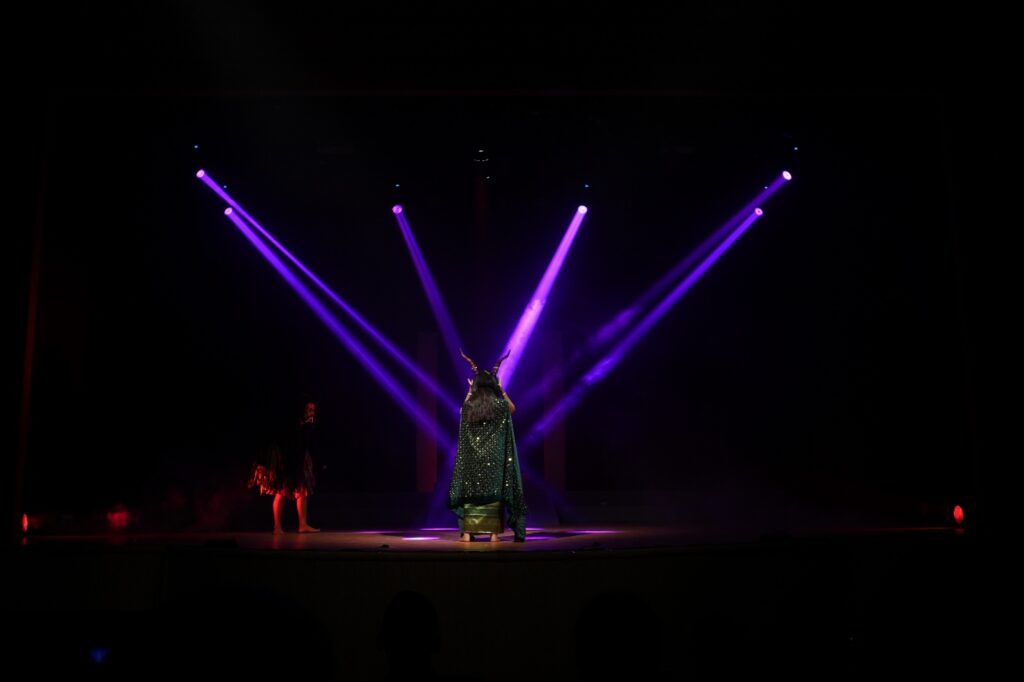

2.Ahimsaka (2024)
Dance Drama Production
Inspired by Buddhist narratives and Tai Khamti folk tales, this work reinterprets the journey of Angulimala through a contemporary dance drama, highlighting themes of transformation and non-violence.


3.Chowpha-Plang-Lu (2022–2023)
Contemporary Drama Production
Presented under the banner of Arunachal Rang Mahotsav, this production portrays the story of unsung hero Ronua Gohain, who took up arms against the British East India Company in 1839, blending Tai Khamti artistic elements with contemporary theatre.


Notable mention: Ai khan Poong
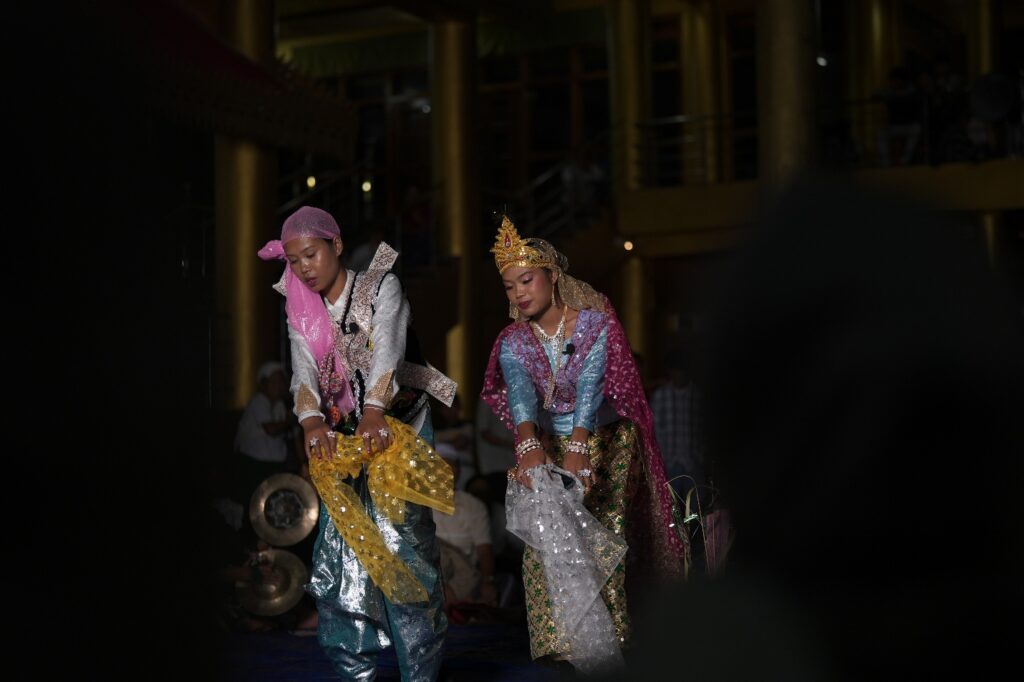
Poong in its earliest form was a male-dominated art. Women were not allowed to engage in performance in any capacity and yet, when a production such as Ai Khan Poong stars two women in the lead, playing the part of man and woman, it presents neoteric perspective and evidence, that contemporary Khamti theatre is not only making a place for itself, but space within itself for community preservation that doesn’t preclude creativity or inclusivity.
Special thanks to:
- Khanthaychaa Namchoom, Member Tai Khamti Heritage and Literature Society
- Chetjawa Mannow, Founder, Laypann Tours and Travels, Riverside Homestay.
***
Sources
- Khanthaychaa Namchoom
- Mantche C. A study on poong (dance-drama) of the Tai-Khamtis. Galore International Journal of Applied Sciences & Humanities. 2020; 4(2): 29-34.
- Mihir Shekhar Bhonsale. Sacred dance dramas where two Buddhist worlds meet: Ka Pung of Tai Khamtis of Northeast India. The Border Lens. 2025.
- https://www.sahapedia.org/ka-pung-through-the-lens
- https://www.sahapedia.org/ka-pung-thammapuktram-directed-nantising-longken
- https://namsai.nic.in/tai-khampti/
- https://echoofarunachal.in/news_details.php?nid=20646
- https://www.facebook.com/DCMChownaMein/videos/from-the-path-of-hinsa-to-ahinsa-witness-the-remarkable-transformation-of-anguli/1224502025908880/
- https://www.facebook.com/100055548266470/posts/folk-theatre-nang-sipsong-brings-tai-khamti-legacy-to-life-at-bharat-rang-mahots/1535238428337751/
- https://www.facebook.com/TheArunachalMirror/posts/a-play-on-chowpha-plang-lu-an-untold-story-of-tai-khamti-uprising-of-1839-leaves/590591696572957/
***
Nang Sanie Mounglang
A hobby writer and first-generation lawyer from Arunachal-Tripura. Her interests include weird wave/strange films and discourse on Identity/gender, art and internet culture.