By Ravi Ranjan
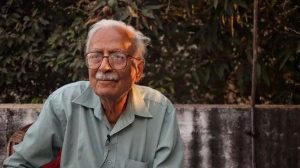
Vinod Kumar Shukla (1937–2025) is an eminent Indian poet, novelist, and short-story writer whose distinctive literary voice left an indelible mark on modern Hindi literature. Over a distinguished career, his contributions were honoured with numerous prestigious national and international accolades.
His poem vicāroṃ kā vistāra isa taraha huā—(And thus the thoughts began to bloom—) begins with an ordinary scene of labour under the scorching sun. A frail man digs muram all day while a thin, hungry boy fills a basket and loads it onto a bullock cart. The shade of a nearby tree lengthens in the evening yet fails to reach them. From this small gap the poet’s thoughts begin to expand. Birds such as the bulbul, wagtail and myna fly from the tree, carrying greenery with them. When one leaf falls, it seems a bird has fallen too; when one shadow departs, another goes with it. This equivalence of greenery and birds, tree and shadow, scene and twilight forms the basic structure of the poem.
As twilight deepens, the sound of the bullock-cart bell merges with the evening star. The sky becomes a ruminating animal that seeks to graze upon all the greenery of the world. Yet if the sky remains where it is, it is merely a bull tied to a stake; if it advances, another sky will accompany it. Thought now expands into the social realm. A single tree on the stony field stands as alone as a green parrot in a cage; even two trees resemble a pair trapped in a cage. A succession of trees, however, creates the joy of organised greenery. The permanent walls of the Satpura and Vindhya ranges become symbols of organised strength. The poet urges organisation that does not leave the Khyber Pass empty, preferring it even to the Himalayas. Even if a parrot hangs outside its cage, its shadow remains inside the cage’s shadow; the shadows of a bowl or a chilli stay confined within the same limits.
The creaking of the cart now sounds like the rumble of an earthquake, yet in the terrible hot wind it brings a cool wave, the scent of moisture and greenery, of rivers, fields and a prosperous population. This sound is a raindrop arriving from the future. One drop falling on the face changes the entire atmosphere into a postcard of cool breezes and good news. After only four or eight drops, the poet thinks of a sentence: good times, happiness in togetherness. The weather is so fine that a two-and-a-half-year-old naked boy runs out of the house; his wife runs after him with his shorts, and the poet deliberately runs slowly so that the son may run a little further ahead. In old age he will not be able to run after his son, yet wherever the boy is the father will be with him. This family scene becomes a symbol of organisation and continuity.
The bullock cart now carries the good time of the future. Loaded upon it is a broken mountain that once obstructed the path of life, turning the road into a cave blocked by rocks. When the mountain breaks, the backward and suppressed poor of centuries emerge, leaving behind the archaeological remains of their poverty—fractured legs, broken nose, broken arm. The surviving torso joins the world of rain, shouldering a plough and stepping into the fields. In the cart laugh and smile the poor bulbul, wagtail, myna, sparrow, women, children and the elderly. A child sitting on the broken peak asks why they do not throw the mountain down from the cart. The grandfather replies that on the way a curious crowd will wish to see the dangerous height lying dead. Children will clap and run, and play in the springs that burst from the breaking mountain.
In the expansion of this sound the poet himself begins to sing, drawing breath from the stability of the earth to the happiness of the future, clenching his fist slowly: “They stepped out, the homeless from behind closed doors, from slums and shanties, from gutters and drains… Let us seize our time, our factories, our gardens, our homes, our grass, even the straw.” So swift that the fragrance of the mango blossom comes first, the orchard later; news of companions first, companions later; faith in a good future first, the good future later; the beginning of work first, the end of work later. The bulbul that sings, the brown-coloured flower, the wagtail and the myna move from this tree to that tree.
A deep reading shows how thought expands from a small scene in a muram field, moving from the personal to the collective, from the natural to the social, from loneliness to organisation, from twilight to clarity. Every shadow, every leaf, every bird, every drop and every sound of the bell joins with the others to announce the greenery of the future. Shukla’s language is as simple as it is profound—no slogans, only the creaking of a bullock cart that slowly shakes the whole world.
English Version of parts of the poem are as follows:
And thus the thoughts began to bloom—
In the direction where
a frail man
has been digging muram
all day long in the sun
from the iron-hard,
rust-eaten,
scorching muram earth,
and with him
a boy
hungry as a whole settlement,
naked and thin,
who fills the dug muram
into a basket
and loads it onto the bullock cart—
the shade of the tree,
yearning hard towards evening,
stretched a little in their direction
yet still fell short of them.
The bulbul that sings,
the brown-coloured flower,
the wagtail and the myna too
were in the tree—
that is why they flew away.
Sorrow came upon the green tree
that hundreds of leaves
must have settled in a flock
together with the birds,
the green leaves’ nesting-place.
That is why the tree is green now:
one leaf clung to one bird.
The yellow leaf
that parted from the tree in the air
fell as a yellow bird.
One leaf went,
one leaf’s shadow went.
The bird sitting still in the tree
is like a part of the tree itself,
and the bird flying far away
to settle on the tree
is the tree’s grown expansion,
flying in the air,
whistling like a flute,
and vanishing.
—One bird went,
one bird’s shadow went.
The tree’s shadow,
broken into pieces,
became the shadows of birds
and went away with the birds.
Greenery will fly away,
the flock of green leaves,
the green thicket,
countless seeds,
with the flocks of birds
to the banks of full rivers,
into the forests;
only a stump will remain
on this hard, stony muram plain.
Greenery went,
greenery’s shadow went.
The scenes are dim
in the twilight;
not one by one
but all together, slowly,
what is seen
is dim,
what vanishes
vanishes into the twilight.
The bird is very small,
the sky too is dim,
a dim star
of evening in the twilight—
yet the sound of the bells
on the bullocks of the approaching,
half-hidden cart
is not dim at all.
That is why the gaze
fell at once upon the evening star:
the bell is that very star
of bronze in the throat of the dim sky.
Yet measured against
the vast throat of the sky
the bell is small;
the moon is just right.
The sky is free,
who knows who set it loose;
ruminating, it has sprawled out,
ready to thrust its mouth
into all the greenery of the world,
heavy and huge,
all the crops,
all the forests
turned towards it,
as it comes slowly
towards the earth!!!
If it stays where it is,
then it is tied to a stake,
waiting to be yoked one day
to the cart of the man who digs muram;
and if it is coming,
perhaps it has already been yoked—
another sky
will be with it as its pair.
In the absolute silence
the sound of the approaching cart
rose clear,
and thus the expansion began:
—A single tree
on the stony plain
stands utterly alone
from the moment of its sprouting
until it withers,
in that same place,
swaying only there,
like a green parrot in a cage.
Two trees
at the most
would be like a pair
in a cage.
—To go in every direction
the tree’s next step
can only be another tree.
The meaning of one tree
moving forward
is a succession of trees,
the joy of organised greenery.
—Like a mountain,
permanent,
standing still,
it grows
into walls
organised in ranges—
the Satpura range,
the Vindhya—
let us too become organised,
yet we must not leave
the Khyber Pass empty;
better than the Himalayas.
—If somewhere outside
in the sun
a parrot’s cage is hung,
still inside the cage,
from above,
within the shadow of the cage
the parrot’s shadow will be,
and within the cage’s shadow
the shadow of a bowl,
the shadow of a chilli,
half-eaten.
The sound of the approaching cart
expanded further.
One must practise
thinking of the green tree
as green.
The tree is visible
in the twilight,
yet it is green;
even at night it will be green.
The expansion of faith in greenery
will come from the tiny bird—
from one tree to another,
from this neighbourhood to that,
from one end
to the farthest end,
along the electric wires,
the telephone poles,
the rims of wells,
the Persian wheels,
this side,
that side,
factories and offices,
sparrows from house to house—
this creaking, grinding sound
of the wheels of the approaching cart.
My thought!!
Like the buried rumble
before an earthquake,
a throb in the earth,
the earth trembling as if
this were some other cart!!
Not the one that carries muram away,
yet it is
the cart of the man who digs muram,
whose sound,
in the terrible hot wind,
sent a cool wave,
the scent of moisture
and greenery,
of rivers, fields
and a prosperous population,
the sound of thousands of miles of scene
rising all at once,
very loud,
as if passing through rain somewhere,
a wet, wet
cool breeze this way—
news of that rain
reached here,
flying on the air
from miles away in the future,
arrived like
a single drop of water on the face,
the experience of all water on the face,
a drop at my address,
a whole atmosphere
in which a postcard
of cool breezes
arrived after many days,
bearing the sense
of everyone’s well-being to come and countless
good pieces of news—
some signal-letter, relation-letter—
a single drop of rain.
After only four or eight drops
I thought of one sentence—
good times—
then another sentence—
happiness in togetherness.
A little carelessness of tomorrow:
the weather so fine
that the laughing two-and-a-half-year-old boy,
naked,
came running out of the house;
behind him
his wife came running
with his shorts in her hand,
complaining to me about our son.
…..
The symbols in the poem are subtle, multi-layered and deeply interconnected. The muram field and the man digging it symbolise the permanent condition of poverty, backwardness and exploitation. Digging muram represents the futility of labour. The hungry boy working beside him stands for the coming generation still trapped in the same cycle.
The tree and its shadow form the most complex symbols. The tree represents greenery, life, happiness and organisation. A single tree is like a green parrot locked in a cage—alone and limited—while two or more trees create sequences and collective strength. The Satpura and Vindhya ranges become symbols of organised revolutionary force. The shadow represents the delicate continuity of life; when one leaf falls, the shadow of a bird also departs.
The birds—bulbul, wagtail, myna, sparrow—symbolise life’s small joys, freedom and collective flight. When they fly away, greenery goes with them; later they return in the cart as laughing, smiling poor birds, symbols of the happiness and liberation of the exploited class.
The bullock cart and the sound of its bell form the central dynamic symbol. At first it seems like the evening star; later it becomes the rumble of an earthquake and a raindrop. The cart symbolises the revolutionary force that breaks the old order. The broken mountain loaded upon it represents the old exploitative system that must be broken. The raindrop symbolises hope, change and the future. One drop falling on the face changes the entire atmosphere and signals good news from afar.
The single tree versus the succession of trees shows the contradiction between loneliness and organisation. The cage and the hanging parrot symbolise oppression; even if the parrot hangs outside, its shadow remains inside. Running slowly behind the son is a tender symbol of generational continuity. The final song moves from personal thought to collective awakening without becoming a slogan.
These symbols never become direct political slogans. They spread slowly from natural scenes to social reality. Every symbol connects with another—shadow with bird, bird with greenery, greenery with organisation, organisation with the cart, the cart with the raindrop, and the drop with the good time of the future.
When the symbols are examined in the light of the Western Symbolist movement of the late nineteenth century, deep theoretical dialogue emerges. Symbolism stood against realism and naturalism, preferring suggestion and evocation over direct description. Baudelaire’s correspondences established hidden affinities between the senses. Mallarmé emphasised linguistic purity and the expression of the inexpressible through ambiguity. Verlaine centred musicality, while Rimbaud placed vision and dream at the heart of poetry. Symbols were suggestive rather than fixed allegories.
In Shukla’s poem, these tenets appear, yet they move beyond purely spiritual or individualistic limits to connect with social-revolutionary reality. The tree is an example of Mallarmé-like suggestive power: a single tree evokes loneliness, while a succession of trees signals collective strength. Like Baudelaire’s correspondences, it links the physical form of nature to inner social reality. The shadow reflects Verlaine’s musicality through the equivalence of leaf and bird, shadow and life. The birds connect with Rimbaud’s visionary gaze, suggesting the transition from individual freedom to collective liberation. The creaking of the cart links the material world of labour to revolutionary reality. The broken mountain and the raindrop shape Symbolism’s mystery into a social context of liberation and hope.
Shukla breaks the limits of Western Symbolism. Where Baudelaire, Mallarmé, Verlaine and Rimbaud sought personal mood and beauty, Shukla’s symbols, while suggestive, point towards social change. Tree, shadow, bird, cart, mountain and drop join together and carry thought from twilight to clarity, steeped in the labour, poverty and hope of Indian soil.
The Indian transformation of Western Symbolism transplants its basic tenets—suggestion, invisible correspondences, musicality of language and mysteriousness—into Indian soil. Symbols acquire a natural and revolutionary dimension by connecting with daily labour, rural reality, collective struggle and human continuity. They work like magical realism: the blend of reality and imagination is so natural that an ordinary scene spontaneously becomes symbolic.
In this poem, the transformation is vivid. The tree is not merely a Symbolist emblem of beauty but a symbol of the greenery and organisation of Indian rural life. The shadow gives Verlaine’s musicality an Indian delicacy linked to the transience of life in the ‘Bhakti tradition’. The birds link Rimbaud’s vision with folk life and become symbols of the return of the exploited class. The cart’s sound is an Indian extension of Mallarmé’s purification; one small sound announces great transformation. The broken mountain and the raindrop turn Baudelaire’s correspondences into Indian hope. Running slowly behind the son transforms Western individualism into generational continuity. This Indian quality appears in Shukla’s other poems as well.
From a sociological perspective, the expansion of thought brings Anthony Giddens’s theory of structuration to life: the dialectic of agency and structure remains dynamic. The worker’s personal situation, determined by capitalist relations of production, turns into a public issue in the manner of C. Wright Mills’s sociological imagination. The poem inverts Marx’s concept of false consciousness; the expansion of consciousness itself challenges the relations of production. It also connects with Pierre Bourdieu’s habitus and field: the workers’ habitus develops the capacity to change the social field. Durkheim’s collective consciousness emerges here from the subtle expansion of everyday sound and imagination rather than from pre-existing unity. In Foucault’s power-knowledge framework, the subtle presence of power generates the possibility of resistance from within. The poem challenges Gramsci’s hegemony by showing that the worker himself can play the role of organic intellectual. Indian sociologists such as Yogendra Singh and André Béteille have discussed the dialectic of tradition and modernity; Shukla shows that the pace of change is slow but inevitable, arising from the depth of daily life.
Eco-criticism reveals nature as an active participant rather than a backdrop. The stony muram field, the slow expansion of the tree’s shadow, the departure of birds and greenery, and the arrival of the raindrop create a complete ecological cycle. Human labour and nature share fatigue. Ecological damage and social change are two aspects of the same process. The earthquake-like sound of the cart expresses both crisis and hope. The broken mountain opens the door to ecological renewal and environmental justice. The raindrop functions like Timothy Morton’s hyperobject, revealing the entire climate cycle. The poem gives an Indian dimension to eco-criticism: nature is neither romantically beautiful nor a passive victim but a co-protagonist that joins human struggle and finally revives with collective change.
Magical realism in the poem arises not from external supernatural intervention but from the depth of reality itself. Everyday experience is looked at in such a way that it reveals magical possibilities. The creaking of the cart becomes the rumble of an earthquake through the collective energy of labour and waiting. One drop becomes a complete postcard of well-being. The broken mountain shoulders a plough and steps into the fields in a process of socio-economic transformation presented as natural. Magic is born from the change of gaze: twilight, shadow and the transformation of star into bell show that reality changes with the way of seeing. This is a slow, Indian rural form of magical realism, born from below—from earth, labour and collective life—rather than from myth or explosive miracle. Language is conversational and simple, yet precisely in that simplicity the subtle changes become powerful.
When the poem is placed in the expansive poetic tradition of Whitman, Neruda, Kedarnath Singh and Nagarjun the nature of expansion differs. Whitman’s expansion is the proclamation of the self embracing the universe. Neruda’s is the surge of collective feeling. Kedarnath Singh’s works through the intellectual sparkle of ordinary images. Nagarjun’s is direct, confrontational and vocal. Shukla’s expansion is a slow, almost silent diffusion, spreading from within like roots or moisture. It is neither declarative nor self-displaying. This silence and slowness give his poetry a rare height in the Hindi tradition.
The artistic beauty of the poem lies in its simple language, gradual expansion and inner music. Conversational language itself becomes poetic resonance. Repetitions such as “one leaf went, one leaf’s shadow went” create a rhythm that draws the reader into the expansion of thought. Small units construct larger structures; the simplicity of language becomes its depth.
In this way the poem establishes that the truth of language lies in its liveliness—its capacity to give form to experience, to expand it, and to make the reader a participant. The poem is not only read; it gradually happens within, and every time creates a new meaning and a new experience. From a muram field to the greenery of the whole world, thought expands slowly, without slogan or bombast, turning the ordinariness of life into something extraordinary and compelling the reader to continue that expansion within himself.
***

Ravi Ranjan: Professor & former Head (Retd.), Department of Hindi, University of Hyderabad.